Is Roofers Eastney the Right Fix?
Most Portsmouth roof problems announce themselves as a damp patch, a slipped tile visible from the street, or debris in the gutter after a storm — not as a dramatic failure.
- Damp patch or staining on an upstairs ceiling after rain
- A tile or slate visibly slipped, cracked or missing
- Granules or mortar fragments collecting in the gutter
- Daylight visible through the roof in the loft
- Lead flashing lifted or showing a thick grey-green patina
When it is not the answer: If more than a third of the covering has failed or nail sickness affects several slopes, repairing tile-by-tile is money wasted Read the full guide.
Local Factors in Portsmouth
Solent salt air and exposed Channel weather corrode fixings and lift tiles faster than inland Hampshire. Portsea Island's dense Victorian terraces mean rear elevations are often reached only through tight alleys, and front scaffold needs permit-controlled pavement space. It is why we specify marine-grade fixings and correct lead codes as standard on Portsmouth roofs — the coastal environment punishes anything less.
What to Expect: Roofers Eastney in Portsmouth
1. Survey
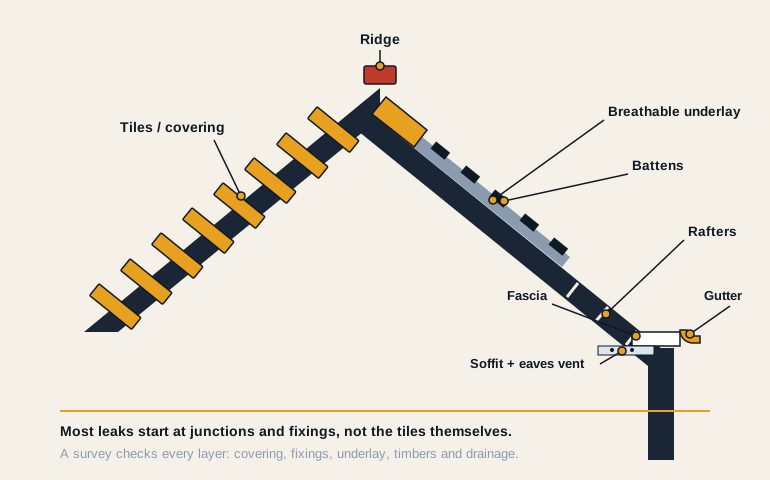
We inspect the roof, trace the actual fault — often metres from the visible stain — and check the wider covering and fixings.
2. Written quote
You get an itemised quote separating investigation, access and repair, with coastal-grade materials specified.
3. Scheduling
We book a slot and arrange any scaffold or tower access in advance.
4. The work
We carry out the repair with marine-grade stainless fixings and flexible ridge compound, not sand-cement.
5. Cleanup & sign-off
We clear debris, walk you through what was done, and issue the written 10-year workmanship guarantee.
Typical Timescales
| Job | Typical duration |
|---|---|
| Slipped or cracked tiles (up to 5) | 1–2 hours |
| Leak diagnosis & repair | Half a day |
| Chimney flashing renewal | Half to full day |
| Rear valley rebuild | 2–3 days |
| Nail-sickness re-fix (per slope) | 1–2 days |
Wet or high-wind days pause tiling and lead work — we build weather margin into every Portsmouth booking.
Getting Safely onto Portsmouth Roofs
Most repairs run from towers or roof ladders; scaffold is quoted only where the job needs safe standing time at height. Scaffold is specified for: chimney-side repairs, full valley rebuilds, and anything beyond a day at height on a two-storey terrace - always itemised in your written quote, never a hidden extra, and we arrange it.
Portsea Island's dense Victorian terraces mean rear elevations are often reached only through tight alleys, and front scaffold needs permit-controlled pavement space. Pavement scaffold and skip permits go through Portsmouth City Council; allow a few working days on streets like Albert Road, Fawcett Road, Marmion Road where space is tight.
Portsmouth Roofers Eastney: Cost Guide
| Job | Typical range | Notes |
|---|---|---|
| Slipped or cracked tiles | £150–£350 | Per visit incl. access |
| Leak diagnosis & repair | £150–£500 | Depends on water travel |
| Chimney flashing | £200–£600 | Code 5–6 lead |
| Valley repair | £400–£900 | Strip and re-lay |
| Nail-sickness re-fix (per slope) | £600–£1,200 | Estate stock |
What moves the price
- Roof height and access on Portsmouth stock
- Coastal-grade materials (marine fixings, code 5–6 lead)
- Extent of hidden salt-corrosion damage found on survey
- Scaffold vs tower vs ladder access
- Conservation constraints where applicable
Worked example: A typical job on a property off Albert Road in Portsmouth, including access and waste removal, sits in the middle of the ranges above once surveyed.
No deposit on repairs under £500. Staged payments on re-roofs — nothing up front before materials are on site. All prices include VAT; written itemised quote before any work.
Covering PO1, PO2, PO3, PO4, PO5, PO6 and surrounding postcodes.
Your Guarantee, Explained
Workmanship on the repaired section is covered for 10 years in writing; any replacement tiles or lead carry their manufacturer warranties on top.
- Covered: workmanship for 10 years, in writing, transferable if you sell.
- On top: manufacturer warranties on materials (terms vary by product).
- Not covered: storm or impact damage - that is an insurance matter, and we will document it for your claim.
If a fault appears in covered work, we come back and put it right. No quibbling, no re-charge.
Living Around the Work
A day of ladder or scaffold work and a small amount of tile debris — we sheet below the work area and clear everything before we leave. You do not need to stay home for external work - we just need power and access agreed in advance.
Repairs run year-round and temporary weatherproofing goes on the same day if rain stops play. Solent salt air and exposed Channel weather corrode fixings and lift tiles faster than inland Hampshire.