Is Chimney Repointing the Right Fix?
Chimney problems show as damp on the ceiling or wall around the chimney breast, crumbling mortar visible on the stack, or debris in the fireplace.
- Damp staining on the chimney breast, inside or upstairs
- Crumbling or missing mortar visible on the stack
- Leaning or bowing stack, or slipped pots
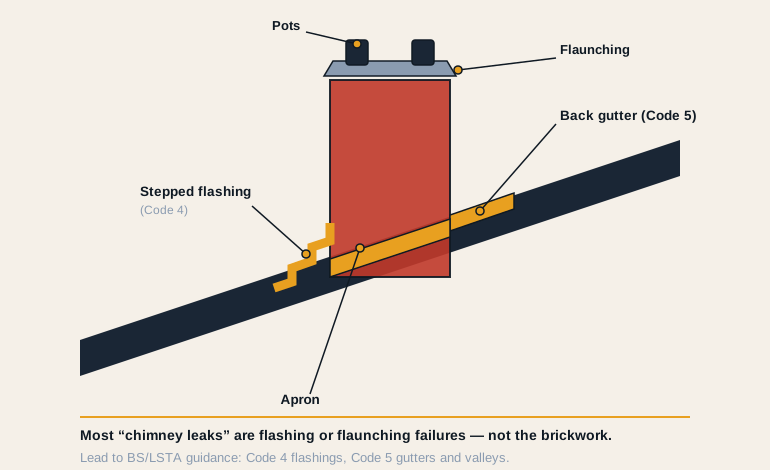
- Lead flashing lifted, split or corroded at the stack base
- Debris or nesting material falling into the fireplace
When it is not the answer: If only the mortar joints have failed, repointing is the answer rather than a full rebuild Read the full guide.
Local Factors in Portsmouth
Solent salt air and exposed Channel weather corrode fixings and lift tiles faster than inland Hampshire. Portsea Island's dense Victorian terraces mean rear elevations are often reached only through tight alleys, and front scaffold needs permit-controlled pavement space. It is why we specify marine-grade fixings and correct lead codes as standard on Portsmouth roofs — the coastal environment punishes anything less.
What to Expect: Chimney Repointing in Portsmouth
1. Survey
We assess the stack, flashing, flaunching and pots, and identify whether repointing, re-flashing or rebuilding is needed.
2. Written quote
An itemised quote specifying lime or cement mortar per the stack's era and coastal lead codes.
3. Scheduling
We book the work and arrange scaffold, coordinating with a neighbour on shared party-wall stacks.
4. The work
We carry out the repair — repointing, re-flashing in code 5–6 lead, re-flaunching or rebuilding as specified.
5. Cleanup & sign-off
Scaffold struck, site cleared, and your workmanship guarantee issued.
Typical Timescales
| Job | Typical duration |
|---|---|
| Flashing renewal | Half to full day |
| Repointing (single face) | Half a day |
| Full stack repointing | 1–2 days |
| Re-flaunching and pots | 1 day |
| Partial rebuild | 2–3 days |
Lime mortar needs dry, frost-free conditions to cure — we plan chimney work around the forecast.
Getting Safely onto Portsmouth Roofs
Stack work at ridge height always needs scaffold or an independent tower for safe working. Scaffold is specified for: all stack work at ridge height — always itemised in the quote and arranged by us - always itemised in your written quote, never a hidden extra, and we arrange it.
Portsea Island's dense Victorian terraces mean rear elevations are often reached only through tight alleys, and front scaffold needs permit-controlled pavement space. Pavement scaffold and skip permits go through Portsmouth City Council; allow a few working days on streets like Albert Road, Fawcett Road, Marmion Road where space is tight.
Your Guarantee, Explained
Chimney workmanship is guaranteed for 10 years; the repair uses era-correct mortar and code 5–6 lead for coastal durability.
- Covered: workmanship for 10 years, in writing, transferable if you sell.
- On top: manufacturer warranties on materials (terms vary by product).
- Not covered: storm or impact damage - that is an insurance matter, and we will document it for your claim.
If a fault appears in covered work, we come back and put it right. No quibbling, no re-charge.
Living Around the Work
Scaffold to the stack for a day or two and some mortar debris — we sheet the area, coordinate shared-stack access, and clear up fully. You do not need to stay home for external work - we just need power and access agreed in advance.
We avoid lime mortar work in frost or heavy rain; flashing and make-safe work can proceed year-round. Solent salt air and exposed Channel weather corrode fixings and lift tiles faster than inland Hampshire.