Emergency roof repairs 24/7 — Call now: 0239 307 1334
★ 4.9/5 · 127 Reviews · Stack Specialists

Chimney Repointing in Portsmouth

Chimney repointing, flaunching, cowls and capping across Portsmouth. Coastal salt and exposure attack stack mortar faster here, and Victorian stacks need lime mortar — not hard cement. We specify correctly for your stack's era and exposure.

📅 Get My Free Quote — Callback Within 2 Hours

Tell us the job in 30 seconds. No pushy sales, no call-out fee.

📞 Call Now: 0239 307 1334

Chimney repointing in Portsmouth costs £150 to £800-plus per stack in 2026, depending on scope and access. Coastal salt and exposure degrade stack mortar faster than inland, and Victorian stacks require lime mortar rather than hard cement to avoid spalling the soft brick. Flaunching, cowls and capping are priced separately. Free survey — call 0239 307 1334.

✓ NFRC Registered
✓ Fully Insured
✓ 10-Year Guarantee
✓ Free Quotes
✓ No Hidden Costs
Roof RepairsRoof ReplacementFlat RoofingEmergencyRoof InspectionsLead RoofingChimney RepointingGutteringGutter CleaningFascias & SoffitsMoss RemovalVelux & SkylightsDry VergeLandlord RoofingCommercial

Why Chimney Repointing Splits from General Chimney Repair

Repointing — raking out failed mortar joints and refilling them with the correct mix — is the most common chimney job in Portsmouth, and it deserves treating as a specialism rather than a footnote to general chimney repair. The reason is the mortar itself. Portsmouth's coastal salt air and driving rain attack exposed stack mortar faster than almost any inland position, and the correct replacement mortar depends entirely on the age and brick of the stack. Get the mortar wrong — most commonly by using hard modern cement on soft Victorian brick — and you cause more damage than you fix. This page covers repointing, flaunching, cowls and capping; storm damage and structural chimney work sit on our chimney repairs page.

Lime Mortar vs Hard Cement — The Critical Choice

This is the single most important decision in Portsmouth chimney work, and the one least experienced roofers get wrong. Victorian and Edwardian stacks were built with soft lime mortar that lets the brick breathe and flex. Modern OPC cement is harder than the Victorian brick around it — so when the joint is repointed in cement, thermal and moisture movement forces the brick face to spall and crumble rather than the mortar. The result is progressive, expensive brick decay. On Portsmouth's Victorian stacks in Fratton, North End, Southsea and Old Portsmouth, lime mortar is not optional; it is the correct specification. On post-war estate stacks in Paulsgrove and Leigh Park, built with modern brick, a frost-resistant cement mix is appropriate. Matching the mortar to the era is the whole job.

Stack Exposure Across Portsmouth

A chimney stack is the most exposed masonry on any building, and Portsmouth's geography makes some stacks far more exposed than others. Seafront Southsea stacks face the full force of Channel weather and prevailing south-westerly salt winds with no shelter, and their mortar fails fastest of any in the city — often needing repointing a decade sooner than sheltered inland stacks. Paulsgrove's ridge position exposes stacks to Meon Valley winds from the north and west. The dockyard-adjacent streets of North End and Stamshaw have a history of accelerated mortar carbonation from the combination of salt air and industrial atmosphere. We assess each stack's specific exposure — which face takes the prevailing weather, how high it stands above the ridge — before specifying the repointing.

Party-Wall Stacks on Portsmouth Terraces

Portsmouth's dense Victorian terraces bring a specific complication: the shared party-wall chimney stack straddling the boundary between two homes. When the mortar on a shared stack fails, both properties are at risk, and proper repointing needs access to the whole stack — which means coordinating with the neighbour. We handle this coordination as standard on Fratton, North End and Southsea terraces, because repointing only your half of a shared stack leaves the other half to keep deteriorating and pushing damp back through the shared flue. A half-stack repair is a false economy that reappears within a few years.

Flaunching, Cowls and Capping

Repointing is often only part of the job. The flaunching — the mortar bed that holds the chimney pots and sheds rainwater off the top of the stack — cracks and fails in Portsmouth's freeze-thaw and salt cycles, letting water into the stack from above; re-flaunching in a durable mix is frequently needed alongside repointing. Cowls fitted to pots keep out rain and birds and improve draught, particularly useful on exposed Portsmouth stacks prone to downdraught. Where a chimney is disused, capping the stack — while retaining ventilation to prevent condensation — stops water ingress permanently. We itemise each of these separately so you see exactly what you are paying for.

How Much Does Chimney Repointing Cost in Portsmouth?

Chimney WorkCost GuideNotes
Repointing (single face, accessible stack)£150–£400Lime or cement per era
Repointing (full stack)£400–£800+Scaffold-dependent
Re-flaunching (pot bed)£150–£350Durable weather-shedding mix
Cowl fitted (per pot)£80–£180Rain, bird and downdraught guard
Chimney capping (disused stack)£200–£500Retains ventilation
Party-wall stack (coordinated)POAFull stack, both sides
Scaffold (two-storey stack)£400–£900Where access requires it

Building Regulations require chimney and flue work to prevent water ingress and maintain structural stability of the stack.

Source: Building Regulations Approved Document J

Free Chimney Survey in Portsmouth

We assess your stack's era, exposure and mortar, specify lime or cement correctly, and itemise repointing, flaunching and cowls. No call-out fee.

Call 0239 307 1334
Reviews

What Portsmouth Customers Say About Our Chimney Work

★★★★★

"Repointed our Southsea seafront stack — they used lime mortar and explained why cement would have wrecked the Victorian brick. Also re-flaunched the pot bed. Proper craftsmen."

Geoffrey R. · Southsea, Portsmouth
★★★★★

"Shared stack on our Fratton terrace — they coordinated with next door and did the whole stack, not just our half. Explained why a half-job would have failed. Sensible."

Angela K. · Fratton, Portsmouth
★★★★★

"Paulsgrove ridge property, stack battered by the wind. They used the right frost-resistant mix for the modern brick and fitted a cowl to stop the downdraught. Sorted."

Brian T. · Paulsgrove, Portsmouth
Honest advice

Is Chimney Repointing the Right Fix?

Chimney problems show as damp on the ceiling or wall around the chimney breast, crumbling mortar visible on the stack, or debris in the fireplace.

When it is not the answer: If only the mortar joints have failed, repointing is the answer rather than a full rebuild Read the full guide.
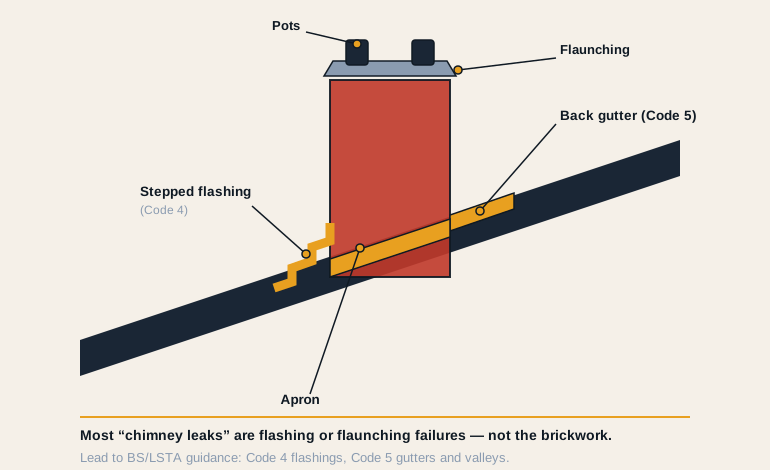
Chimney stack lead weatherproofing: pots, flaunching, stepped flashing, front apron and back gutter
Correct lead flashing — apron, steps and back gutter — is what keeps a stack watertight.
Local factors

Local Factors in Portsmouth

Solent salt air and exposed Channel weather corrode fixings and lift tiles faster than inland Hampshire. Portsea Island's dense Victorian terraces mean rear elevations are often reached only through tight alleys, and front scaffold needs permit-controlled pavement space. It is why we specify marine-grade fixings and correct lead codes as standard on Portsmouth roofs — the coastal environment punishes anything less.

The process

What to Expect: Chimney Repointing in Portsmouth

1. Survey

We assess the stack, flashing, flaunching and pots, and identify whether repointing, re-flashing or rebuilding is needed.

2. Written quote

An itemised quote specifying lime or cement mortar per the stack's era and coastal lead codes.

3. Scheduling

We book the work and arrange scaffold, coordinating with a neighbour on shared party-wall stacks.

4. The work

We carry out the repair — repointing, re-flashing in code 5–6 lead, re-flaunching or rebuilding as specified.

5. Cleanup & sign-off

Scaffold struck, site cleared, and your workmanship guarantee issued.

Timescales

Typical Timescales

JobTypical duration
Flashing renewalHalf to full day
Repointing (single face)Half a day
Full stack repointing1–2 days
Re-flaunching and pots1 day
Partial rebuild2–3 days

Lime mortar needs dry, frost-free conditions to cure — we plan chimney work around the forecast.

Access

Getting Safely onto Portsmouth Roofs

Stack work at ridge height always needs scaffold or an independent tower for safe working. Scaffold is specified for: all stack work at ridge height — always itemised in the quote and arranged by us - always itemised in your written quote, never a hidden extra, and we arrange it.

Portsea Island's dense Victorian terraces mean rear elevations are often reached only through tight alleys, and front scaffold needs permit-controlled pavement space. Pavement scaffold and skip permits go through Portsmouth City Council; allow a few working days on streets like Albert Road, Fawcett Road, Marmion Road where space is tight.

Guarantee

Your Guarantee, Explained

Chimney workmanship is guaranteed for 10 years; the repair uses era-correct mortar and code 5–6 lead for coastal durability.

If a fault appears in covered work, we come back and put it right. No quibbling, no re-charge.

Good to know

Living Around the Work

Scaffold to the stack for a day or two and some mortar debris — we sheet the area, coordinate shared-stack access, and clear up fully. You do not need to stay home for external work - we just need power and access agreed in advance.

We avoid lime mortar work in frost or heavy rain; flashing and make-safe work can proceed year-round. Solent salt air and exposed Channel weather corrode fixings and lift tiles faster than inland Hampshire.

Prefer to talk it through? A local Portsmouth roofer will answer — call 0239 307 1334.

FAQ

Frequently Asked Questions

Chimney repointing costs £150 to £400 for a single accessible face and £400 to £800-plus for a full stack, depending on access and scaffold. Flaunching, cowls and capping are itemised separately.

Victorian and Edwardian stacks need lime mortar — hard cement spalls the soft period brick. Post-war estate stacks with modern brick use a frost-resistant cement mix. We match the mortar to the era on every job.

Coastal salt air and driving rain attack stack mortar faster than inland, especially on exposed seafront and ridge positions. Using the wrong mortar — cement on Victorian brick — accelerates the failure further.

Flaunching is the mortar bed holding the pots and shedding rain off the stack top. It cracks in Portsmouth's freeze-thaw and salt cycles, letting water in from above. Re-flaunching is often needed alongside repointing.

We coordinate with the neighbour and repoint the whole stack. Repointing only your half leaves the other side deteriorating and pushing damp back through the shared flue — a false economy that reappears in a few years.

A cowl keeps out rain and birds and reduces downdraught — useful on exposed Portsmouth stacks prone to wind. For disused stacks, capping with retained ventilation stops ingress permanently.

Two-storey stacks usually need scaffold or tower access for safe working. We include access in every written quote and, on terraces, arrange any pavement permit required. Call 0239 307 1334.

Related Services

Related Roofing Services in Portsmouth

Chimney RepairsRoof RepairsLead RoofingLeadworkRoof InspectionsMoss RemovalStorm DamageRoof Replacement
Get In Touch

How Do I Get a Free Quote?

No call-out fees. No obligation. Local Portsmouth roofers.

0239 307 1334