Nail sickness is the corrosion of roofing nails that leaves sound tiles slipping off the roof. It's endemic on Portsmouth's post-war estates — Paulsgrove, Leigh Park, Bridgemary — where galvanised fixings from the 1950s-70s have reached end of life in coastal-adjacent air. Re-fixing with marine-grade stainless solves it.
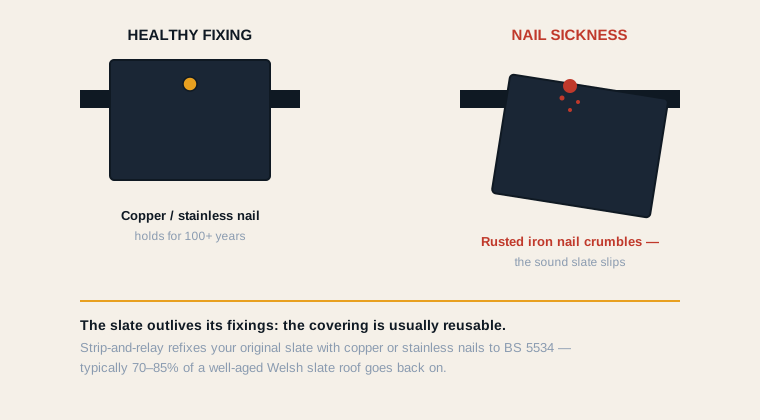
If you live in Paulsgrove, Leigh Park, Buckland, Wymering or any of Portsmouth's post-war housing estates, there's a reasonable chance your roof is affected by nail sickness. It is the single most common roofing problem we diagnose across Portsmouth's post-war housing stock, and it is accelerating as properties built in the 1940s, 50s and 60s reach the end of their original nail design life.
How to Assess Nail Sickness Without Roof Access
From the ground: look for tiles that have slipped slightly out of alignment across a slope, tiles with their lower edge raised compared to adjacent tiles, or a history of tile loss in moderate wind events that would not affect a sound roof. These signs suggest nail sickness but are not definitive. The only reliable assessment requires access to the roof and direct inspection of the fixing nail on a sample of tiles — this is a free service we offer on request.
Re-Fix vs Full Re-Roof for Portsmouth Estate Properties
Where nail sickness is localised to one slope and tiles are otherwise sound, targeted re-fixing with marine-grade stainless ring-shank nails is economically viable. Where nail sickness is present across multiple slopes, the cumulative cost of sequential targeted repairs typically exceeds the cost of a full re-roof with marine-grade fixings — which then carries a 10-year guarantee and should not require attention for 30 to 40 years.
Nail Sickness and Insurance
Nail sickness is maintenance deterioration rather than sudden damage — most buildings insurance policies do not cover it. However, storm tile loss caused by nail-sick tiles may be partially claimable depending on policy terms and insurer interpretation. An insurer that identifies nail sickness as the underlying cause may reject or reduce the storm damage claim. The practical implication: maintaining your roof against nail sickness is both structurally sensible and protects your insurability.
What is Nail Sickness?
Nail sickness is the corrosion of the galvanised steel nails or clips that hold concrete roof tiles in place. When these fixings corrode, the tiles lose their mechanical attachment to the roof and are held in place only by gravity and friction. A nail-sick tile is essentially sitting loose on the roof, and will lift and slide in storm conditions. The tiles themselves can look perfectly sound from the ground — the tiles aren't cracked or broken, they're just no longer attached.
BS 5534 now mandates corrosion-resistant fixings specifically to prevent the nail fatigue failures seen on older roofs.
Source: British Standard BS 5534
Why Portsmouth Has So Much Nail Sickness
Age: Most of Portsmouth's post-war estates — Paulsgrove, Buckland, Landport, Wymering, and Leigh Park in Havant — were built between 1945 and 1965. Original galvanised nails have a design life of 40–60 years in normal conditions. These properties are now 60–80 years old, firmly in and beyond the failure window.
Coastal environment: Portsmouth's island position means galvanised fixings corrode faster than the manufacturer's inland design life assumes. Salt air from the Solent and the two harbours accelerates oxidation. Properties on exposed positions — Paulsgrove's chalk ridge, Leigh Park's elevated site, Southsea's seafront — show faster nail sickness progression than sheltered positions.
How to Identify Nail Sickness
- Tiles that have slipped downward, creating irregular lines in previously straight tile courses
- Rust staining on tiles — the corroding nail creates a red-brown streak running down the tile face
- Tiles that have lifted at the lower edge, creating visible gaps at the lap
- Daylight visible through the roof deck when viewed from the loft
- History of multiple tile losses from the same roof in storm events
Nail Sickness Options — Repair vs Re-Roof
| Option | When Appropriate | Cost (3-bed semi) |
|---|---|---|
| Mechanical re-fix (individual slopes) | 1–2 slopes affected, tiles sound | £600–£1,400 per slope |
| Full re-fix (all slopes) | All slopes affected, tiles still sound | £2,000–£3,500 |
| Full re-roof | Tiles also damaged, deck needs attention, roof over 60 years | £7,000–£10,500 |
The decision between re-fix and re-roof depends on the condition of the tiles themselves. If the concrete tiles are surface-eroding or showing porosity problems in addition to nail sickness, re-fixing them costs nearly as much as a re-roof while extending the life of a substandard surface. We assess this honestly at survey.
What Happens if Nail Sickness is Left Untreated
Untreated nail sickness progresses until tiles lose contact with the roof surface. In a storm, wind gets under a lifted tile edge and removes tiles rapidly — sometimes in large numbers in a single weather event. Water ingress follows quickly, potentially causing structural and ceiling damage below. Emergency repair in this scenario costs significantly more than a planned assessment and re-fix.
Last reviewed: 20 July 2026 by Portsmouth Roofing Experts.